Rolex rarely creates one of one watches for a public sale, so the arrival of four unique Cosmograph Daytonas in London immediately feels different from an ordinary new watch launch.
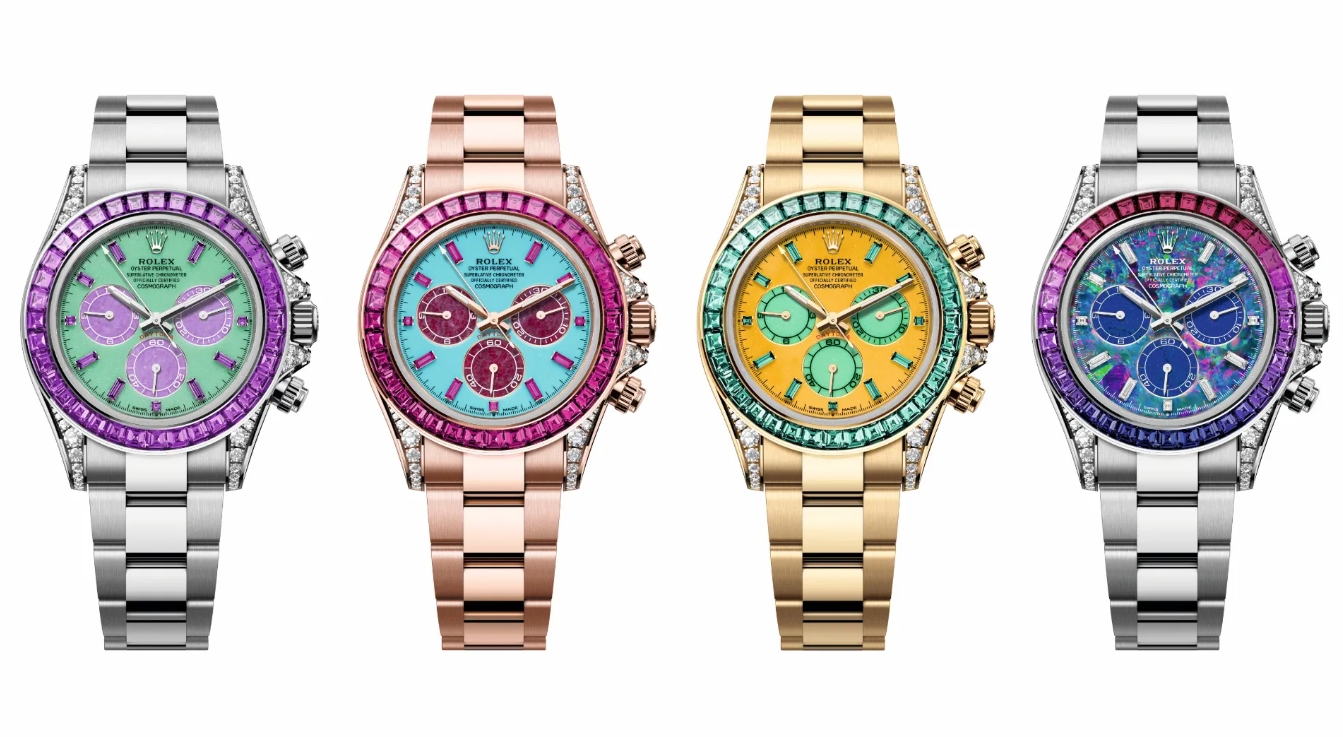
Known collectively as the Four Seasons, the watches represent Spring, Summer, Autumn and Winter through four different combinations of precious metals, natural stone dials and gemstones. Phillips will auction them individually in London on 28 September 2026, with all proceeds benefiting the Federer Foundation and Re:wild.
It is also an important event for another reason: this is the first Rolex charity auction organised with Phillips, making these watches unusual not only because of their materials but because of why they were created.
For readers who follow replica watches in the UK, there is an important distinction from the outset. The four watches in this auction are genuine, factory-made Rolex Cosmograph Daytonas. Their value here is as a reference point for understanding how complex natural stone dials, gemstone settings and precious-metal Daytona cases actually look when Rolex executes them.
Quick Facts
- Event: Rolex Four Seasons charity auction
- Date: 28 September 2026
- Location: London
- Auction house: Phillips in Association with Bacs & Russo
- Number of watches: Four unique Cosmograph Daytonas
- Lots: Each watch will be offered individually
- Beneficiaries: Federer Foundation and Re:wild
- Movement: Rolex calibre 4131
- Power reserve: Approximately 72 hours
Why the Rolex Four Seasons Auction Matters
Gem-set Daytonas are not new to Rolex. The company has produced some remarkably extravagant versions of its chronograph over the years, including models combining precious metals, diamonds and coloured sapphires.
What makes the Four Seasons project different is that each watch exists as a unique piece. Rolex has not simply introduced four new references into the commercial catalogue. Instead, each Daytona was created around a specific seasonal theme and a specific charitable event.
The basic Daytona architecture remains familiar. Each watch still uses the three-counter chronograph layout, Oyster case and current-generation calibre 4131. Yet almost every visible decorative element has been reconsidered through colour and material.
That balance between an established sports chronograph and high jewellery is what makes the Rolex Four Seasons Daytona auction in London particularly interesting.
Spring Brings Chrysoprase and Purple Sapphire Together
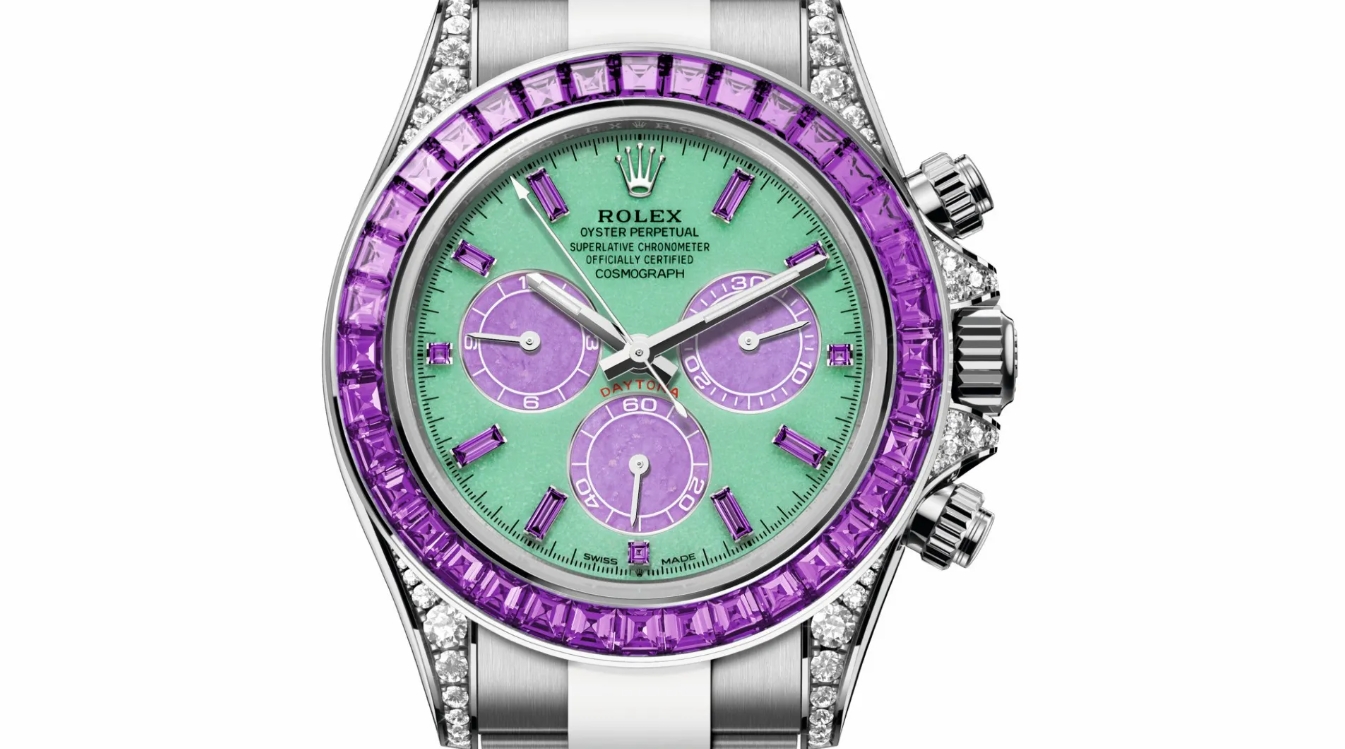
Spring is housed in 18 ct white gold, which gives Rolex a relatively neutral foundation for one of the more unusual colour combinations in the set.
The dial is crafted from chrysoprase, while lepidolite is used for the chronograph counters. Against the fresh green dial surface, Rolex introduces purple sapphires for both the hour markers and bezel.
Eight baguette-cut purple sapphires and three square-cut purple sapphires serve as the hour markers. Around the case sits a bezel containing 36 trapeze-cut purple sapphires.
The lugs and crown guards are then set with 54 brilliant-cut diamonds.
What works here is the contrast rather than outright visual excess. The white-gold case stays relatively quiet while green and purple dominate the centre of the watch. It is probably the most obviously spring-like interpretation of the four.
It also demonstrates why natural stone Rolex Daytona dials cannot really be understood by colour alone. Chrysoprase has its own texture and variation, so reproducing the character of the surface involves more than finding the right shade of green.
Summer Is the Warmest of the Four
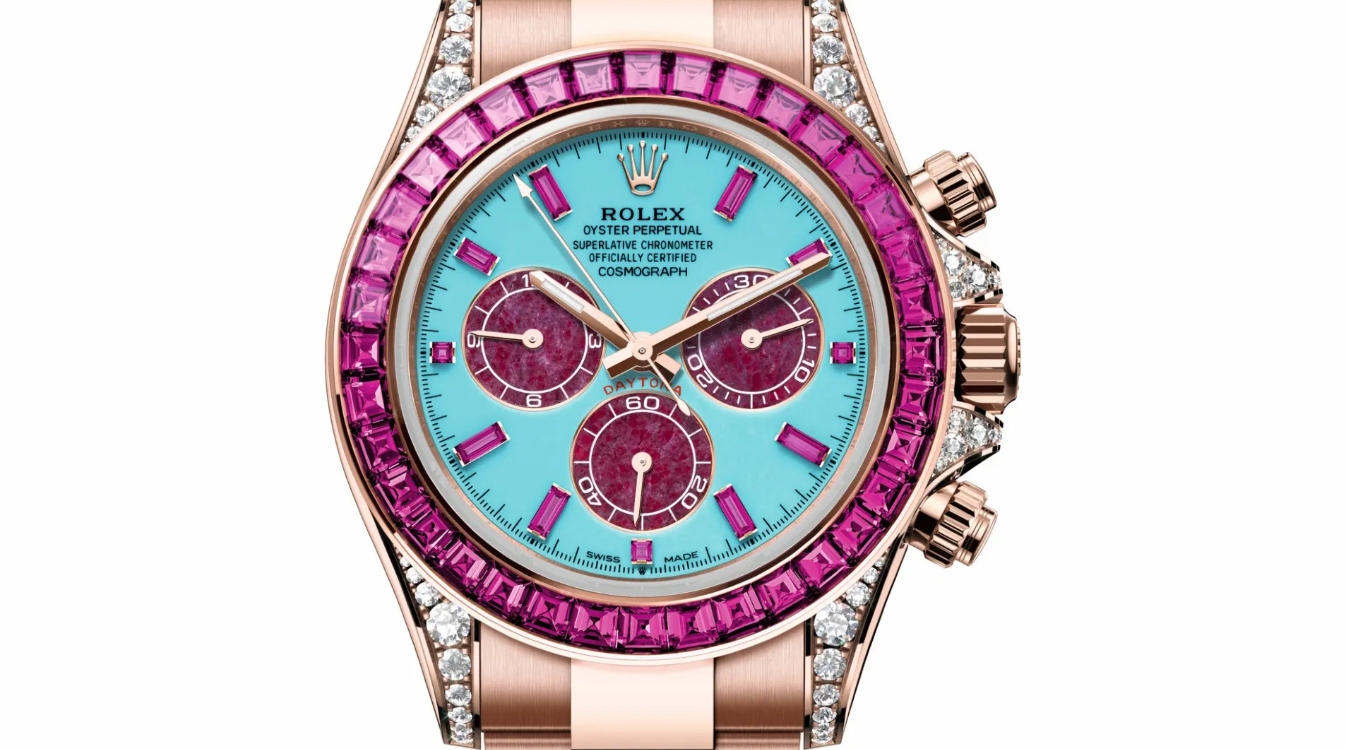
Summer switches from white gold to 18 ct Everose gold and pairs the warmer metal with a turquoise dial.
The chronograph counters are made from heart of ruby, providing a deeper red tone at the centre of the dial. Eight baguette-cut pink sapphires and three square-cut pink sapphires form the hour markers, while another 36 trapeze-cut pink sapphires fill the bezel.
As on Spring, 54 brilliant-cut diamonds are set into the lugs and crown guards.
This is probably the boldest colour contrast in the collection. Turquoise sits naturally against the pink tone of Everose gold, while the ruby counters add a darker point of focus.
It is worth being precise about these materials. The counters are heart of ruby, while the bezel and hour markers use pink sapphires. Treating them all simply as “red stones” misses one of the details Rolex has deliberately built into the watch.
Autumn Uses the Most Earthy Palette
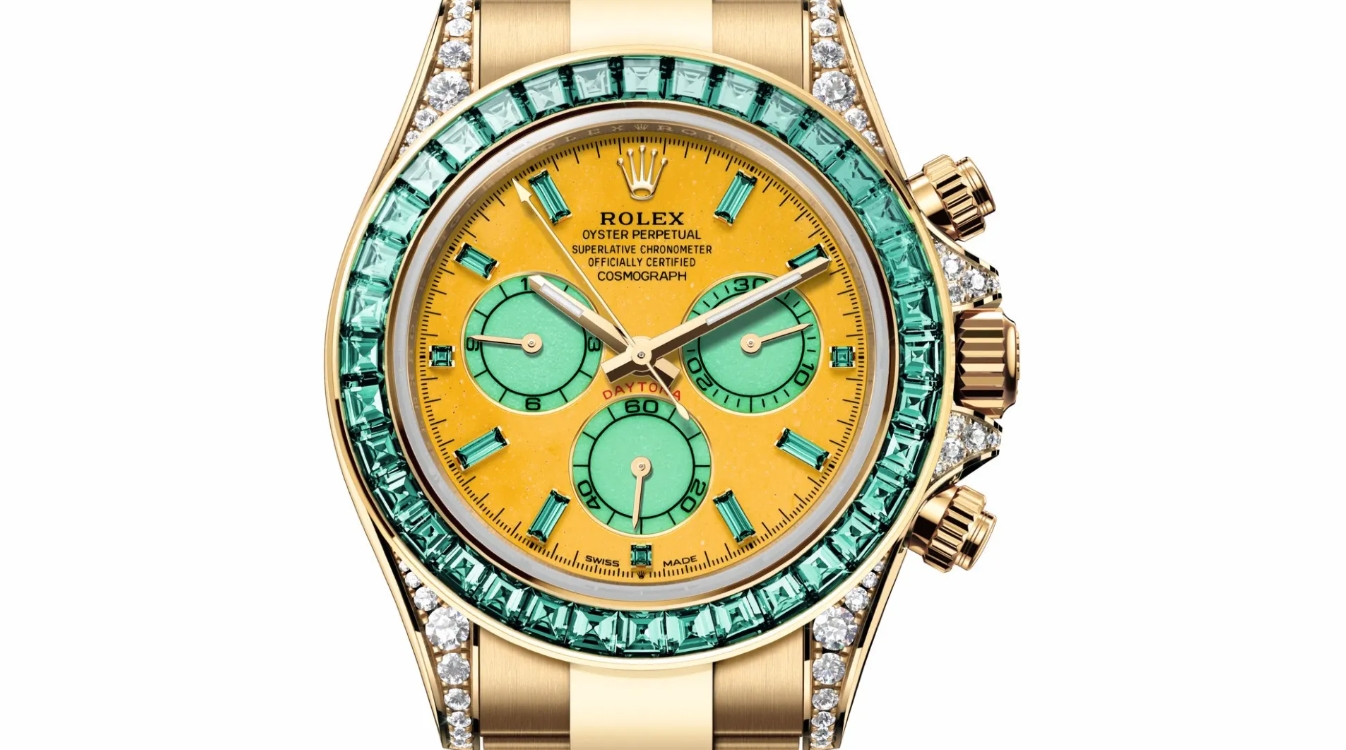
The Autumn Daytona uses an 18 ct yellow-gold case and bracelet with a mookaite dial.
Of the four watches, this is probably the palette that needs the least explanation. Yellow gold and the earthy tones found in mookaite naturally suit an autumn theme.
Rolex uses chrysoprase for the chronograph counters, while green tourmalines add contrast around the dial and bezel.
There are eight baguette-cut and three square-cut green tourmalines for the hour markers, plus 36 trapeze-cut green tourmalines around the bezel. The lugs and crown guards are again finished with 54 brilliant-cut diamonds.
The interesting part is how different Autumn looks from Spring even though both watches use green. On Spring, green comes primarily from the dial. On Autumn, the green stones sit against a much warmer yellow-gold and mookaite foundation.
This is a good example of why gem-set Rolex Daytona details need to be judged as a complete composition rather than by gemstone colour alone.
Winter Is the Most Dramatic Daytona of the Set
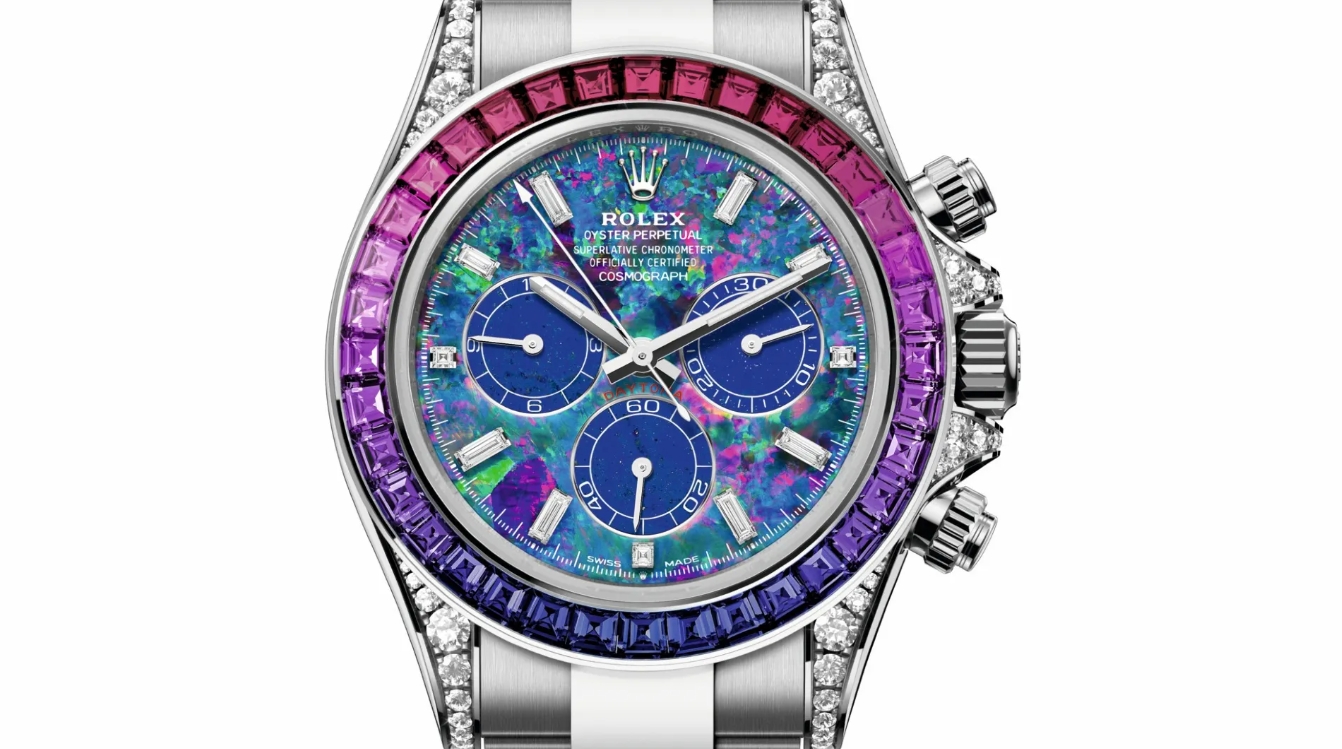
Winter moves into 950 platinum and is visually cooler from the beginning.
The dial is blue opal, while lapis lazuli forms the three chronograph counters. Instead of coloured gemstone hour markers, Rolex uses eight baguette-cut diamonds and three square-cut diamonds.
The bezel then introduces colour again through 36 trapeze-cut sapphires arranged in a gradient moving from blue towards fuchsia.
The diamond-set lugs and crown guards continue the same construction used throughout the collection.
For me, Winter is the most visually complex watch of the four. The blue opal already has considerable depth before the gradient sapphire bezel is added, while platinum keeps the case itself visually neutral.
It also illustrates one of the hardest details to imitate convincingly. A gradient bezel does not depend only on using the correct colours. The transition, stone size, spacing and setting all have to work together.
Four Watches Compared
| Season | Case | Dial | Counters | Bezel |
|---|---|---|---|---|
| Spring | 18 ct white gold | Chrysoprase | Lepidolite | Purple sapphires |
| Summer | 18 ct Everose gold | Turquoise | Heart of ruby | Pink sapphires |
| Autumn | 18 ct yellow gold | Mookaite | Chrysoprase | Green tourmalines |
| Winter | 950 platinum | Blue opal | Lapis lazuli | Blue to fuchsia sapphires |
All four watches use Rolex calibre 4131 and carry the same basic modern Cosmograph Daytona chronograph architecture beneath their dramatically different exteriors.
The Natural Stone Dials Are More Important Than the Photographs Suggest
The gemstones naturally attract attention first, but the dial materials may ultimately be the more interesting part of these watches.
Natural stone does not behave like lacquer or a conventional painted surface. Colour distribution, texture and pattern can vary from one section of stone to another.
That matters particularly on watches intended to be unique. Even if someone could reproduce the overall colour scheme, reproducing the exact character of a specific piece of chrysoprase, mookaite or blue opal would be considerably more difficult.
It is one reason photographs of natural stone watches can be misleading. A flat product image may show the colour clearly but reveal much less about depth, texture and variation.
The Gem Setting Is About Geometry as Much as Colour
Another detail worth looking at is the shape of the stones around each bezel.
Rolex uses 36 trapeze-cut stones rather than simply filling the bezel with conventional round gemstones. That allows the individual stones to follow the circular shape much more closely.
Spring uses purple sapphires, Summer pink sapphires and Autumn green tourmalines. Winter adds another layer of complexity by arranging sapphires through a blue-to-fuchsia gradient.
Spacing matters. Stone dimensions matter. Colour consistency matters. On Winter, the progression from one colour to another matters as well.
For anyone later comparing a watch inspired by these designs, those details are much more revealing than a seller simply describing it as high grade or 1:1.
All Four Daytonas Use Calibre 4131
Behind the decorative work is the same movement generation found in the current Cosmograph Daytona family.
Rolex calibre 4131 is an automatic chronograph movement with an official power reserve of approximately 72 hours. The four auction watches are also Superlative Chronometer certified.
Those are specifications of the genuine Rolex watches being auctioned.
They should not automatically be applied to visually similar replica watches. A replica may use a completely different automatic chronograph movement even when its dial and case follow the appearance of a current Daytona.
This distinction is especially important when discussing Rolex Daytona calibre 4131 comparisons. The useful question is not simply whether a movement resembles a genuine Rolex calibre visually, but what movement is actually installed, how it functions and whether it can realistically be serviced.
Why the Charity Element Changes the Story
The Four Seasons project is not simply an exercise in rare materials.
All proceeds from the four auction lots will benefit the Federer Foundation and Re:wild.
The Federer Foundation supports educational opportunities for children, particularly in Southern Africa and Switzerland. Re:wild works with communities and conservation organisations to protect and restore the natural world.
The seasonal theme therefore has a connection with the wider purpose of the event. The four watches use colour and natural materials to represent Spring, Summer, Autumn and Winter, while the proceeds support education and environmental conservation.
Why London Matters for UK Watch Readers
The sale takes place in London on 28 September 2026, with Phillips offering each Daytona as an individual lot.
For UK watch followers, that makes this much more than an overseas auction story. Four factory-created one of one Daytonas will appear together in London, giving collectors a rare opportunity to see how the market responds to modern Rolex watches whose uniqueness was established from the moment they were made.
There is also no conventional catalogue price to use as a meaningful benchmark. Their final results will instead depend on the individual watches, their rarity, the charitable purpose of the event and the willingness of bidders in the room.
What Replica Watch Readers Should Actually Compare
Readers of BuyWatches often arrive here because they are interested in replica watches rather than high-end auction collecting. These four Daytonas are still useful because they show exactly which details become important when a design moves far beyond a conventional steel sports watch.
If Four Seasons-inspired replica versions appear, begin with the dial rather than the marketing description.
- Does the dial actually resemble the natural stone used by Rolex?
- Are the chronograph counters the correct colour and texture?
- Are the bezel stones the correct shape?
- Does the Winter bezel show a controlled colour gradient?
- Are the hour markers consistent with the correct seasonal model?
- Does the case material match what is actually being claimed?
- What movement is genuinely installed inside the watch?
A gold-coloured steel case is not 18 ct gold. A printed blue surface is not blue opal. A decorated automatic movement is not Rolex calibre 4131.
These distinctions matter when comparing Rolex Cosmograph Daytona replica watches, particularly when the original reference relies so heavily on unusual materials.
Which Four Seasons Daytona Stands Out Most?
There is no objective answer, but each watch succeeds for a different reason.
Spring has perhaps the freshest colour combination. Summer offers the strongest contrast. Autumn feels the most immediately connected to its season. Winter is the most technically and visually dramatic.
What ties them together is that Rolex has resisted changing the underlying Daytona formula. Instead, the company has used material and colour to create four completely different personalities from essentially the same chronograph architecture.
That is what makes the collection more interesting than four simple gem-set variations.
Frequently Asked Questions
Are the Four Seasons Daytonas replica Rolex watches?
No. All four watches are genuine unique Rolex Cosmograph Daytonas made for the Four Seasons charity auction.
When is the Rolex Four Seasons auction?
The auction will take place in London on 28 September 2026.
How many Four Seasons Daytonas are there?
There are four unique watches, representing Spring, Summer, Autumn and Winter. Each watch will be sold as a separate lot.
Which movement do the watches use?
All four use Rolex calibre 4131, with an official power reserve of approximately 72 hours.
Where will the auction proceeds go?
All proceeds will benefit the Federer Foundation and Re:wild.
Final Thoughts
The Four Seasons Daytonas work because Rolex has not abandoned the familiar identity of the Cosmograph Daytona. The case architecture, chronograph layout and movement remain recognisable, while natural stone and gem setting completely change the personality of each watch.
Spring combines white gold, chrysoprase and purple sapphire. Summer brings together Everose gold, turquoise and pink sapphire. Autumn uses yellow gold, mookaite and green tourmaline. Winter pairs platinum with blue opal, lapis lazuli and a graduated sapphire bezel.
The materials are spectacular, but rarity is only part of the story. These are four genuine one of one Rolex watches created for a charity auction, with all proceeds going to organisations connected with education and conservation.
For replica watch readers, the most useful takeaway is simpler: the more unusual the genuine watch becomes, the less meaningful generic quality labels become. Comparing a Rolex Daytona replica with the genuine reference requires looking carefully at the dial, gemstone arrangement, case construction, movement and proportions rather than relying on a single claim about quality.